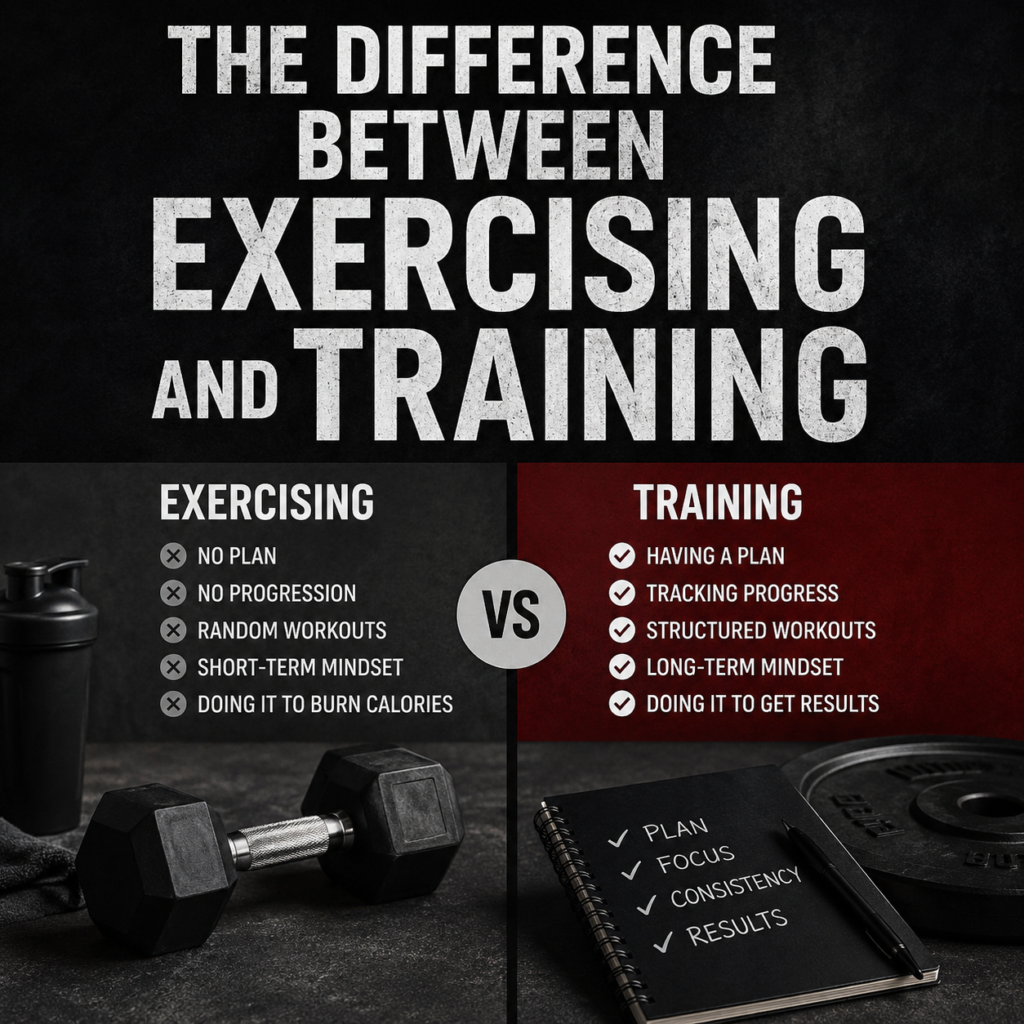
Most people think they’re training.
The reality is that most people are simply exercising.
Now, there’s nothing wrong with exercise. Exercise is good for your health. It burns calories, improves cardiovascular fitness, reduces stress, and gets you moving. The problem is that many people have physique goals, strength goals, and health goals that require more than simply showing up and moving around.
They want to build muscle.
They want to lose body fat.
They want to look athletic.
They want to transform their physique.
But they’re approaching their workouts like someone who is exercising, not someone who is training.
And that’s why they often spend years in the gym without seeing the results they want.
What Is Exercise?
Exercise is physical activity performed for general health, fitness, or calorie expenditure.
Examples include:
- Going for a walk.
- Taking a fitness class.
- Running on a treadmill for 30 minutes.
- Doing random exercises at the gym.
- Following whatever workout you happen to find online that day.
Exercise is often unstructured.
The goal is simply to move.
Again, there’s nothing wrong with that. In fact, exercise is infinitely better than doing nothing at all.
But if your goal is to completely change your body, improve your strength, or maximize your health and performance, exercise alone may not be enough.
What Is Training?
Training is structured exercise performed with a specific outcome in mind.
Training follows a plan.
Training measures progress.
Training has purpose.
Training involves performing specific exercises, in a specific order, with specific sets, reps, and progression strategies designed to move you closer to a defined goal.
Whether your goal is building muscle, getting stronger, improving athletic performance, or losing body fat, training is the process that gets you there.
Every workout serves a purpose.
Every exercise is selected for a reason.
Every week builds upon the previous one.
The Biggest Difference: Progression
The biggest difference between exercising and training is progression.
Someone who is exercising might perform the same workout for years.
The weights never increase.
The exercises never change.
Nothing is tracked.
Nothing is measured.
Nothing improves.
Someone who is training is constantly looking for ways to progress.
Maybe they add five pounds to a lift.
Maybe they perform an extra rep.
Maybe they improve their technique.
Maybe they increase their training volume.
The goal is simple: become better than you were last week.
Because if your body has no reason to adapt, it won’t.
Why Most People Stay Stuck
One of the biggest mistakes I see in the fitness industry is people confusing activity with achievement.
They think because they’re sweating, they’re making progress.
They think because they’re exhausted after a workout, it must have been effective.
They think because they’re spending five days a week in the gym, results should automatically follow.
Unfortunately, that’s not how the body works.
Your body doesn’t care how tired you are.
It doesn’t care how sweaty you get.
It doesn’t care how many hours you spend in the gym.
Your body responds to specific demands.
If those demands aren’t increasing over time, your results will eventually stall.
Signs You’re Exercising Instead of Training
You may be exercising instead of training if:
- Every workout is different.
- You don’t track your weights or reps.
- You choose exercises based on what feels exciting that day.
- You judge workouts by how sweaty you get.
- You have no clear goal.
- You never review your progress.
- Your strength hasn’t improved in months or years.
These habits are incredibly common.
And they’re often the reason people become frustrated with their results.
How To Start Training Instead Of Exercising
The good news is that making the transition isn’t complicated.
Start by setting a clear goal.
Do you want to build muscle?
Lose body fat?
Get stronger?
Improve your health markers?
Once you have a goal, build a structured plan around it.
Track your workouts.
Record your weights, reps, and sets.
Monitor your nutrition.
Pay attention to your recovery.
Most importantly, focus on improving over time.
Small improvements performed consistently for months and years will outperform random hard workouts every single time.
Final Thoughts
Exercise is great.
Training is better when you have a specific goal.
If your objective is simply to move more and improve your general health, exercise can absolutely help.
But if you’re frustrated because your physique isn’t changing, your strength isn’t improving, or your results have stalled, it may be time to stop exercising and start training.
The people who achieve the best results aren’t necessarily the ones who work the hardest.
They’re the ones who follow a plan, track their progress, and stay consistent long enough for those efforts to compound.
Don’t just show up.
Train with purpose.
Your body will thank you for it.
Yours in Good Health,
Nick Cosgrove
Forever Fit Performance