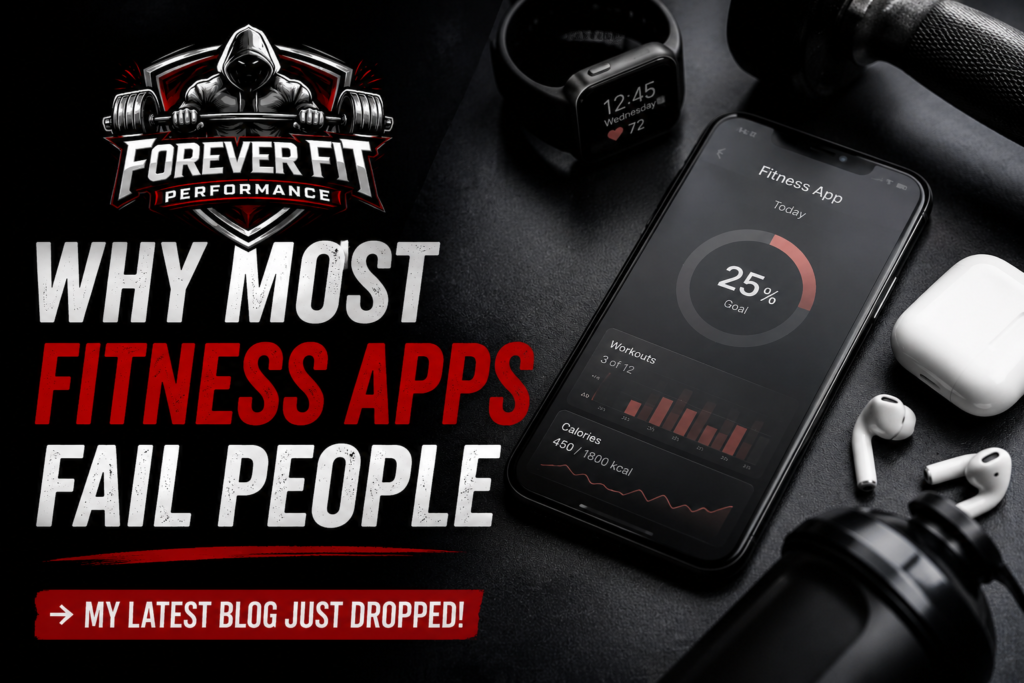
Fitness apps have never been more popular.
There are thousands of options promising to help you lose fat, build muscle, get stronger, improve your health, and finally achieve the body you’ve always wanted.
And yet, despite having access to more information than ever before, obesity rates continue to climb, gym dropout rates remain high, and most people still struggle to achieve long-term results.
So what’s the problem?
The problem isn’t technology.
The problem is that most fitness apps try to solve a highly individual problem with a generic solution.
One Size Fits Nobody
Most fitness apps are built around templates.
You answer a few basic questions, select a goal, and within seconds you’re given a workout plan and nutrition recommendations.
It feels personalized.
But it isn’t.
The reality is that no app knows your injury history, training experience, stress levels, recovery capacity, work schedule, lifestyle habits, strengths, weaknesses, or how your body responds to training.
Two people can have the exact same goal and require completely different approaches to achieve it.
Yet most apps deliver nearly identical programs.
Information Isn’t The Same As Coaching
One of the biggest misconceptions in fitness is that people fail because they lack information.
That’s rarely the case.
Most people already know they should exercise regularly, eat more protein, get enough sleep, and stay consistent.
The issue isn’t knowledge.
The issue is implementation.
An app can tell you what to do.
A coach helps you actually do it.
A coach provides accountability, adjusts your plan when life gets busy, helps you navigate setbacks, and makes changes when progress stalls.
An app simply can’t replicate that level of support.
Progress Requires Adjustments
One of the biggest reasons clients hire coaches is because their program evolves as they evolve.
What works today may not work three months from now.
As your body changes, your training, nutrition, recovery, and overall strategy often need to change as well.
Most fitness apps don’t make meaningful adjustments.
Instead, they continue feeding you the same workouts and recommendations regardless of your results.
A good coach constantly evaluates progress and makes decisions based on real-world feedback.
Motivation Eventually Disappears
Many apps rely heavily on motivation.
Streaks.
Badges.
Notifications.
Achievements.
Those things can be helpful in the beginning.
But eventually, the novelty wears off.
When motivation disappears, structure becomes far more important.
Long-term success isn’t built on excitement.
It’s built on habits, discipline, accountability, and consistency.
That’s where most apps fall short.
They Can’t See The Full Picture
Let’s say you’ve been following a program for six weeks and your weight hasn’t changed.
An app may assume the plan isn’t working.
A coach might discover:
- You’re sleeping four hours per night.
- Your stress levels are through the roof.
- You’re skipping meals on weekends.
- Your strength is increasing.
- Your body measurements are improving.
- Your adherence has only been 60%.
Those details matter.
Progress is rarely as simple as what the scale says.
Without understanding the full picture, it’s impossible to make intelligent decisions.
The Reality
Fitness apps aren’t necessarily bad.
They can be useful tools.
For some people, they’re a great starting point.
But tools are not the same as coaching.
If you’ve been bouncing from app to app, workout to workout, and diet to diet without getting the results you want, the problem may not be your effort.
The problem may be that you’re relying on a system that was never designed specifically for you.
Because at the end of the day, real results don’t come from following a generic template.
They come from having a plan that’s built around your goals, your lifestyle, and your individual needs—and making the adjustments necessary to keep moving forward.
That’s something no fitness app has figured out how to do.
Yours in Good Health,
Nick Cosgrove
Forever Fit Performance