One of the most common questions I get from clients is:
“How many calories should I be eating?”
It’s a fair question.
After all, calories matter. If you’re consuming more calories than you burn, you’ll gain weight. If you’re consuming fewer calories than you burn, you’ll lose weight.
But here’s the reality:
Calories are only part of the story.
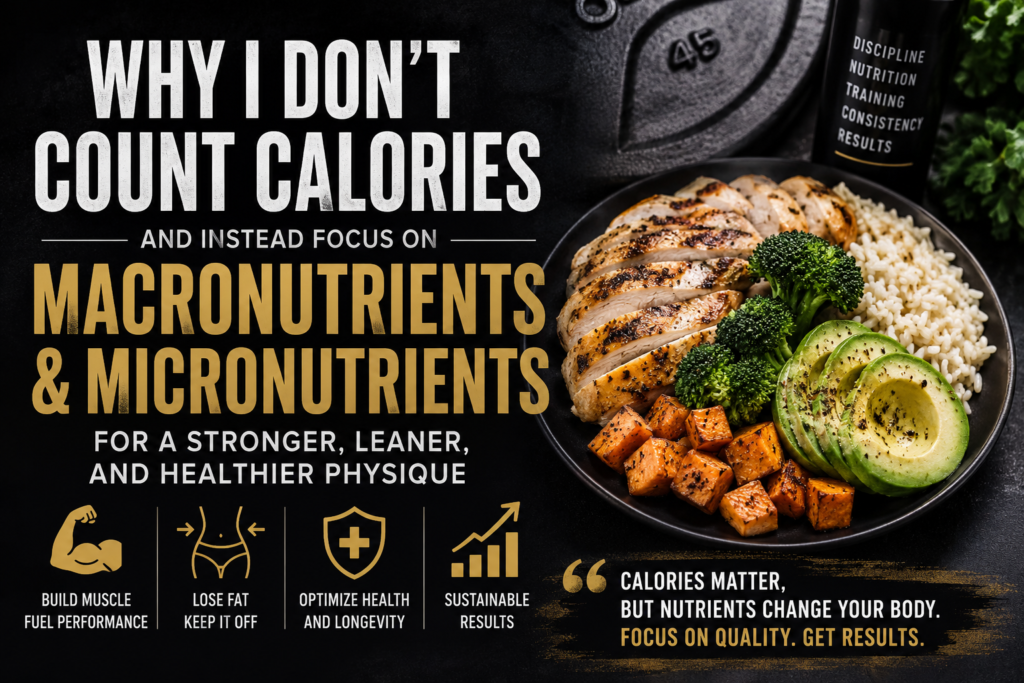
When I’m designing a nutrition plan for a client whose goal is to lose body fat, build muscle, improve performance, or simply become healthier, I don’t focus on calories first.
I focus on macronutrients and micronutrients.
Why?
Because your body doesn’t just need energy.
It needs the right nutrients.
Not All Calories Are Created Equal
A calorie is simply a unit of energy.
That’s it.
Your body doesn’t recognize calories as “healthy” or “unhealthy.”
But it absolutely recognizes protein, carbohydrates, fats, vitamins, minerals, fiber, and water.
You could technically eat the same number of calories from fast food and junk food as someone eating lean proteins, fruits, vegetables, healthy fats, and quality carbohydrates.
The calorie total might be identical.
The results will not be.
One diet provides the nutrients needed to build muscle, recover from training, support hormone production, maintain energy levels, and optimize health.
The other simply provides energy.
Macronutrients Determine How Your Physique Looks
When it comes to changing your physique, macronutrients are what matter most.
Protein helps build and maintain muscle tissue.
Carbohydrates fuel performance and recovery.
Dietary fats support hormone production, joint health, brain function, and overall well-being.
If protein intake is too low, muscle growth suffers.
If carbohydrate intake is inadequate, training performance often decreases.
If fat intake is too low, hormone function can become compromised.
This is why two people eating the exact same number of calories can end up looking completely different.
The calorie total may be the same.
The macronutrient breakdown is not.
Micronutrients Matter More Than Most People Realize
Most people obsess over calories while completely ignoring vitamins and minerals.
That’s a mistake.
Micronutrients support hundreds of processes throughout the body, including:
- Energy production
- Immune function
- Recovery
- Hormone production
- Muscle contractions
- Sleep quality
- Cognitive performance
You cannot expect your body to perform optimally if it’s constantly running on nutrient-poor food.
The goal shouldn’t simply be to hit a calorie target.
The goal should be to provide your body with the nutrients it needs to thrive.
Calories Don’t Tell the Whole Story
Let’s look at a simple example.
Imagine two individuals each consume 2,500 calories per day.
Person A consumes:
- Lean proteins
- Rice, potatoes, oats, and fruit
- Vegetables
- Healthy fats
Person B consumes:
- Fast food
- Sugary snacks
- Alcohol
- Processed foods
The calorie intake is identical.
But everything else is different.
Recovery.
Performance.
Muscle growth.
Hunger levels.
Energy.
Health markers.
Body composition.
Calories alone don’t explain those outcomes.
Nutrient quality does.
Why I Build Nutrition Plans Around Macros
When I work with clients, I don’t hand them a generic calorie target and tell them to figure it out.
I establish macronutrient targets based on:
- Their body weight
- Activity level
- Training frequency
- Lifestyle
- Goals
- Metabolism
- Recovery demands
This allows us to create a structured plan that supports muscle growth, fat loss, performance, and long-term adherence.
The calorie total becomes a byproduct of the macronutrient prescription.
Not the other way around.
The Goal Isn’t Weight Loss. The Goal Is Body Composition.
Many people become obsessed with losing weight.
I care far more about improving body composition.
There’s a huge difference.
Losing weight doesn’t necessarily mean you’re healthier.
It doesn’t necessarily mean you’re leaner.
And it certainly doesn’t mean you’re building muscle.
My goal is to help clients lose body fat while maintaining or increasing lean muscle mass whenever possible.
That’s why focusing solely on calories often misses the bigger picture.
The Bottom Line
Calories matter.
Anyone who says they don’t is wrong.
But calories are only one piece of the puzzle.
When it comes to building a stronger, leaner, healthier physique, the quality of those calories matters.
Protein matters.
Carbohydrates matter.
Healthy fats matter.
Vitamins matter.
Minerals matter.
That’s why I don’t build nutrition plans around calories.
I build them around macronutrients and micronutrients.
Because my goal isn’t simply helping someone weigh less.
My goal is helping them build a physique and level of health they can maintain for life.
Yours in Good Health,
Nick Cosgrove
Forever Fit Performance